
Choosing an A Level homeschool in Malaysia gives students real freedom, and that freedom is exactly why revision can slip. There is no school bell, no form teacher and no classmates revising in the next row. A Cambridge A Level rewards steady effort across two years, not a sprint in the final month. This guide shows how to build a weekly routine around live lessons, independent study, past papers and revision. Exam readiness then grows week by week instead of arriving as a last-minute panic.
Why does an A Level homeschool student need a study routine?
The qualification is long, deep and unforgiving of gaps. Cambridge A Levels usually run over two years, with students studying three or four subjects in depth. The AS Level covers half the content of the full A Level, so the first year already carries real weight. At home, nobody notices a missed Tuesday unless the plan makes it visible. A routine turns vague intentions into fixed slots, and it protects rest, which matters just as much. Cambridge holds exams twice a year, in May/June and October/November, so the routine should work backwards from the series your child is aiming for. Our Cambridge A Level page explains how the AS and A2 stages fit together.
How should you organise weekly study time across subjects?
Start with what is fixed: live lessons. At Dreamtime Learning Asia, A Level learners study one-to-one with Cambridge-trained educators through the Elite (1-on-1) programme, so those sessions anchor the week. Build everything else around them. Give each subject at least two independent study blocks a week, and give the hardest subject a third. Pair a numbers-heavy subject with an essay-heavy one on the same day, so the brain switches gears instead of tiring out.
Keep one flexible block for catching up and one half-day fully off. Add a short planning session on Sunday evening to set the week. Write the plan on a single page and keep it where the student sees it every morning. For a feel of how an online day runs in practice, read a day in the life of an online IGCSE student in Malaysia.
How do you balance live lessons, independent learning and revision?
Think in three layers. Within 24 hours of each live lesson, the student writes a short summary from memory. Each week, they test themselves on the previous week’s topics. Each month, they mix older topics into a short review. This follows one of the clearest findings in learning research. A well-known review by Dunlosky and colleagues, published by the Association for Psychological Science, rated practice testing and spreading study over time as the most useful techniques. Rereading and highlighting scored low. In plain terms, closing the book and trying to recall beats reading the notes again.
A good A Level revision timetable simply schedules these layers. Students aiming for the May/June 2027 series have roughly six months from today, which is enough to cover each topic several times.
How can past papers and timed practice reveal knowledge gaps?
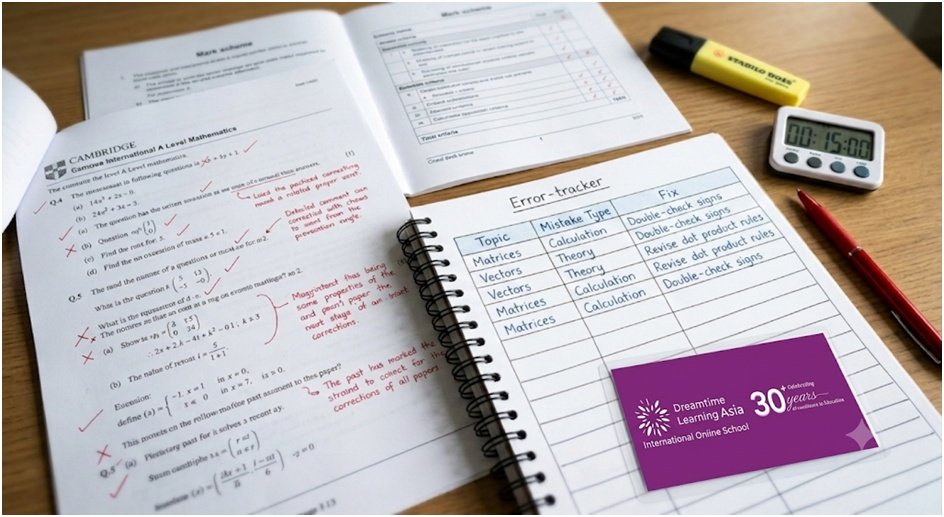
Cambridge publishes past papers, specimen papers and mark schemes for every AS and A Level subject. Its own guidance for students is simple: practise under exam-day conditions, then use the mark scheme to assess your performance. Start with topic questions while content is still being learnt. Move to full timed papers once a subject is mostly covered.
After every paper, log each lost mark in an error tracker. Label it as a knowledge gap, an application slip, a timing problem or a misread command word. Patterns appear quickly. If three papers show the same weak topic, it moves into next week’s plan. Treat the first score as a map, not a prediction.
How can parents and teachers monitor progress without micromanaging?
Agree three numbers and review them once a week: study hours completed, past papers attempted and marks by topic. A fifteen-minute conversation around a shared tracker is enough. Ask the student what went well, what stalled and what changes next week. Teachers add the academic view and can say whether a gap is a quick fix or needs reteaching. At Dreamtime Learning Asia, mentors support learners academically and emotionally, and the learning platform tracks assignments and progress, as described on our approach page. Review the whole plan monthly, and change it without guilt when it stops working.

When should you seek extra A Level support before exams?
Act early if the same topic loses marks across three papers, if the student falls more than two weeks behind the timetable, or if confidence drops sharply. Also check the practical side. Homeschool candidates normally sit Cambridge exams through an approved centre, such as British Council Malaysia, not directly with Cambridge. Some syllabus options are not open to private candidates. For the June series, standard entry deadlines have fallen in mid-February in several countries in recent years, so confirm Malaysian dates with your centre well ahead. If you want guided help, our enrolment process explains the steps, and you can book a trial class to see a live lesson first.
Frequently Asked Questions
How many hours should an A Level homeschool student study each week?
Cambridge sets no single figure. It depends on the subjects and the student’s starting point. Agree weekly targets with the teacher, track what actually happens for a month, then adjust.
Ask questions instead of giving answers, help with planning, and avoid editing their work. “What have you tried?” is a strong prompt.
Start a light revision cycle about six months before. Keep new learning and revision running side by side, and shift to intensive timed past papers in the final weeks.
Can homeschool students sit Cambridge A Level exams in Malaysia?
Yes, through an approved Cambridge exam centre. Candidates cannot register directly with Cambridge, and not every option is open to private candidates, so confirm your subjects early.
Yes. AS results can be carried forward to a full A Level within the limits Cambridge sets. Check the current rules with your exam centre before planning.
Build the routine now, not in March
A routine does not make A Level easier. It makes effort visible, repeatable and measurable. Start with one page: fixed lessons, study blocks, a weekly self-test and one rest half-day. Adjust it every month. To see how this works for your child, explore our Cambridge A Level programme or enquire now to speak with an admissions counsellor.