
Parents of an A Level homeschool student in Malaysia often face the same puzzle. Their teenager is almost an adult, and still needs them. Step in too much, and the student stops owning the work. Step back too far, and small problems grow quietly. This guide explains how parent support for A Level students can change across the two years. It also covers how to talk about progress without adding pressure, and when to step in or step back.
Why does parental support change during the A Level years?
By A Level, students are usually 16 to 19, choosing subjects and working towards a qualification that belongs to them. The parent’s job shifts from manager to coach. Research supports this. A meta-analysis of 36 studies found that parent autonomy support was linked with higher achievement and healthier motivation and well-being. A separate three-level meta-analysis found that parents’ homework involvement overall was weakly related to lower achievement, while autonomy support was the one positive dimension.
These studies show associations, not guarantees. They do suggest that how you help matters more than how much you help. At Dreamtime Learning Asia, Cambridge A Level learners study one-to-one with Cambridge-trained educators, so the parent’s role is to support, not to teach.
How can parents discuss academic progress without creating pressure?
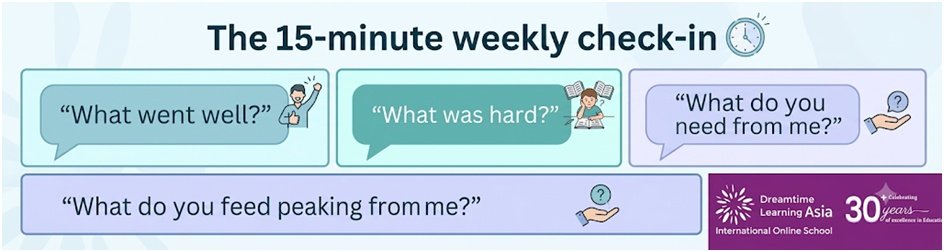
Pick a calm, regular time, and keep it short. A weekly 15-minute check-in works better than daily questioning. Let the student speak first. Three open questions are enough: What went well this week? What was hard? What do you need from me? Avoid comparing your teenager with siblings or friends.
Praise planning and persistence, not only marks. Marks are a result. The habits behind them are what the student can actually change. If your teenager shares a weekly plan or tracker, ask about it with curiosity, not suspicion. Our guide to building an A Level study routine shows what a good plan looks like, so you know what to listen for.
When should parents step in, and when should teenagers solve problems themselves?
A useful rule: let the student own problems they can solve and that carry low risk, and step in when the risk is high or they ask. Planning, small missed tasks and choosing how to revise belong to the student. Health, repeated missed lessons and fixed deadlines belong to a shared conversation.
Ask before you help: “Do you want me to listen, or help solve this?” That one question protects the relationship. Some admin tasks do need a parent. Homeschool candidates sit Cambridge exams through an approved centre, such as British Council Malaysia, so confirm registration steps and deadlines together early.
How can parents encourage accountability and realistic goals?
Set goals with your teenager, not for them. Agree on one or two targets per term, such as finishing a set of topics or completing timed papers. Treat past-paper results as information, not a verdict. Agree in advance what happens if a target slips: a revised plan, not a punishment.
Check goals against the teacher’s view. Educators see the student’s work every week and can say whether a target is realistic. The school lists progress visibility and regular parent communication on its approach page, so use it. Sleep, phone habits and breaks also belong in the plan, because tired students plan badly.
How can you tell a student needs more support, and where can you turn?
Watch for patterns, not single bad days. Academic signs include the same topic losing marks across papers, missed lessons, or falling behind the plan by more than a couple of weeks. Other signs include changes in sleep, withdrawing from family, irritability, or avoiding any talk about studies.
Wellbeing deserves attention. A 2025 peer-reviewed analysis of Malaysia’s 2022 national adolescent survey found that about 27% of 33,523 school-going 13- to 17-year-olds reported depressive symptoms. That is a screening result, not a diagnosis, but it shows how common the strain is. Talk first, then involve the teacher. If you are worried about wellbeing, speak to a GP or counsellor. In a crisis, the Malaysian Mental Health Association lists Talian Kasih at 15999 and Befrienders KL at +603 7627 2929, both 24 hours.
How do you keep a healthy parent–teen relationship during demanding exam periods?
Separate study talk from family time. Many families agree on no-study-talk meals, which gives everyone a break. Acknowledge stress out loud: “This is a heavy term, and you are handling it.” Keep routines for sleep, food and exercise steady, and model calm yourself.
Apologise when you overstep. Teenagers notice, and it teaches them how to repair conflict. Remember the long view: the relationship will last far longer than the exams. If you worry about isolation in online learning, our piece on friendships in online school offers ideas.
Frequently Asked Questions
Involved enough to stay informed and supportive, but not enough to run the student’s day. A weekly check-in, help with admin tasks and attention to wellbeing is a good balance.
Ask questions instead of giving answers, help with planning, and avoid editing their work. “What have you tried?” is a strong prompt.
Choose low-pressure moments, such as a walk or a drive, and listen first. Ask the teacher for regular feedback so you are not the only channel.
A Level is a test of study skills as much as subject knowledge, and a supportive parent helps most by building the student’s ownership. To see how one-to-one teaching works for your teenager, book a trial class or enquire now. You can also read about the enrolment process first.